
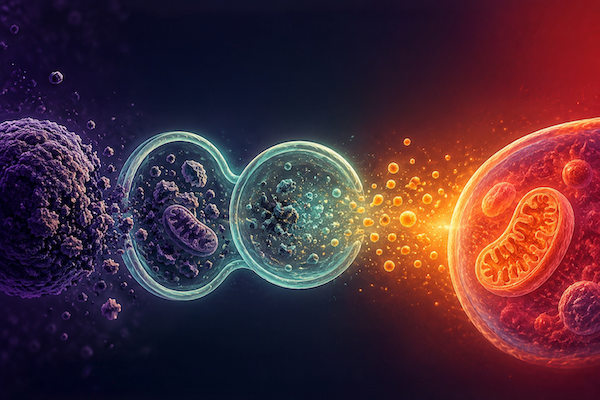
If there’s one cellular process that has drawn so many people to fasting, it’s autophagy. Often referred to as the body’s internal recycling system, autophagy is a self-cleaning process that allows our cells to detoxify, repair, and regenerate – without any fancy supplements or procedures (Levine & Kroemer, 2019).
Autophagy fasting offers one of the most profound ways to tap into your body’s innate healing abilities. Whether you’re aiming for detox, better brain health, stronger immunity, or hormone balance, incorporating autophagy-supportive fasts into your lifestyle could be a game changer.
Autophagy literally means “self-eating,” but don’t worry – this process is not only beneficial, it’s essential. When you're in a fasted state and glucose (your body's primary energy source) isn't being supplied through food, your cells switch into a resourceful, self-preserving mode. They do something remarkable: they begin “cleaning house” – breaking down old, damaged components, digesting dysfunctional proteins, and eliminating cells that are malfunctioning or potentially harmful (Levine & Kroemer, 2019).
This process not only conserves energy, but also supports cellular health and longevity.
Imagine your body as a house. Inside this house, every room represents an organ or system, each busy with daily tasks – cooking, cleaning, repairing, and building. Just like any home, this activity produces waste. In your body, this waste appears as damaged proteins, faulty mitochondria, dysfunctional cells, and inflammatory debris (Mizushima & Levine, 2020).
Now imagine never taking out the trash. Waste piles up, things start to smell, and eventually, the clutter affects the structure of your home. Without autophagy, your body accumulates cellular junk that contributes to inflammation, brain fog, insulin resistance, hormonal imbalances, and chronic disease (Galluzzi et al., 2017).
Autophagy results in a cleaner, healthier internal environment. Cells function more efficiently. Hormones are better regulated. And a brain that feels clearer and more focused because the neural “rooms” have been swept and decluttered.
Autophagy is your body’s way of hauling the trash to the curb. And just like routine garbage collection, consistent fasting keeps your internal environment cleaner, more balanced, and more functional.
When glucose isn't regularly entering your system, cells switch from growth mode to maintenance mode. This metabolic stress triggers hormesis, a biological response where mild stress stimulates healing and adaptation (Mattson, 2015). Autophagy is one of the key adaptive responses – your body’s way of cleaning up, repairing, and upgrading itself.
Think of autophagy as a dimmer switch, not an on/off button. It gradually intensifies the longer you remain in a fasted state. While the exact timing varies by individual factors like age, glucose levels, and metabolic health, studies suggest:
• Autophagy can begin around the 17–20 hour mark, especially when fasting is done consistently and insulin levels remain low (Longo & Panda, 2016).
• Peak autophagy typically occurs between 48 and 72 hours of fasting (de Cabo & Mattson, 2019).
• Shorter fasts still offer measurable benefits and can stimulate early-stage autophagy when practiced consistently (de Cabo & Mattson, 2019).
You don’t need to fast for 72 hours to experience results. Many women report improvements in metabolic health, energy, and mental clarity with regular 17-20 hour fasts.
Autophagy supports cellular health in three powerful ways:
• Detox – Cells eliminate waste, damaged organelles, and toxins, which helps reduce inflammation and oxidative stress (Galluzzi et al., 2017).
• Repair – Mitochondria and other cellular structures are repaired or rebuilt, improving energy production and function (Mizushima & Levine, 2020).
• Disease prevention – The body removes abnormal or precancerous cells, which may reduce the risk of neurodegeneration, cancer, and autoimmune conditions (Menzies, Fleming, & Rubinsztein, 2015).
Autophagy fasting may be especially beneficial for women in perimenopause and post-menopause, as it helps address some of the key health challenges that arise with hormonal changes.
Estrogen decline is associated with insulin resistance. Fasting helps retrain the body to use insulin efficiently, supporting weight regulation and energy levels (Longo & Anderson, 2022).
Proper detoxification of estrogen is critical during this life stage. Fasting aids liver and gut function, which are essential for estrogen clearance (Pedre, 2020).
With lower estrogen levels, many women experience brain fog or memory issues. Fasting enhances cellular clean-up in the brain and may boost brain-derived neurotrophic factor (BDNF), improving focus and clarity (de Cabo & Mattson, 2019).
Autophagy clears out old or dysfunctional immune cells, strengthening the immune system’s ability to respond effectively (Levine & Kroemer, 2019).
While fasting doesn’t restore lost hormones, it lowers inflammation, stabilizes insulin, and supports detox – all of which help the endocrine system function more smoothly (Longo & Anderson, 2022).
These benefits build over time with consistent fasting, nourishing meals, and lifestyle practices like movement, rest, and connection.
Start with consistent, shorter overnight fasts (12–14 hours) to improve insulin sensitivity (your body’s ability to use insulin efficiently) and lay a foundation for steady energy and metabolic health. A simple, supportable place to begin is with our New Moon 30-Day Reset Guides
These guides are designed in three progressive levels, allowing you to build confidence at your own pace. You’ll start with shorter fasts and phase-based nutrition, then gradually incorporate ketobiotic and hormone-style eating, and eventually layer in movement and exercise – all aligned with the principles of Dr. Mindy Pelz’s work and tailored for women in midlife and beyond.
When you're ready to explore longer fasts (24–72 hours), schedule a Wellness Check-in first. Extended fasting requires thoughtful preparation, including proper hydration, electrolyte balance, and an understanding of blood sugar and ketone dynamics.
With the right guidance, you can avoid common pitfalls and learn exactly which drinks, supplements, and foods support your fast – and how to break it safely to maximize your results.


• de Cabo, R., & Mattson, M. P. (2019). Effects of intermittent fasting on health, aging, and disease. New England Journal of Medicine, 381(26), 2541–2551. https://doi.org/10.1056/NEJMra1905136
• Galluzzi, L., Pietrocola, F., Levine, B., & Kroemer, G. (2017). Metabolic control of autophagy. Cell, 159(6), 1263–1276. https://doi.org/10.1016/j.cell.2014.11.006
• Levine, B., & Kroemer, G. (2019). Biological functions of autophagy genes: A disease perspective. Cell, 176(1–2), 11–42. https://doi.org/10.1016/j.cell.2018.09.048
• Longo, V. D., & Anderson, R. M. (2022). Fasting, cellular stress resistance, and hormonal health in women. Aging Research Reviews, 76, 101556.
• Longo, V. D., & Panda, S. (2016). Fasting, circadian rhythms, and time-restricted feeding in healthy lifespan. Cell Metabolism, 23(6), 1048–1059. https://doi.org/10.1016/j.cmet.2016.06.001
• Mattson, M. P. (2015). Hormesis defined. Ageing Research Reviews, 24, 1–7. https://pubmed.ncbi.nlm.nih.gov/18162444
• Menzies, F. M., Fleming, A., & Rubinsztein, D. C. (2015). Compromised autophagy and neurodegenerative diseases. Nature Reviews Neuroscience, 16(6), 345–357. https://pubmed.ncbi.nlm.nih.gov/25991442
• Mizushima, N., & Levine, B. (2020). Autophagy in human diseases. New England Journal of Medicine, 383(16), 1564–1576. https://doi.org/10.1056/NEJMra2022774
• Nair, P. M., & Khawale, P. G. (2016). Role of therapeutic fasting in women's health: An overview. Journal of Mid-Life Health, 7(2), 61–64. https://doi.org/10.4103/0976-7800.185325

